A teacher’s perspective on an IT manager’s role when supporting autonomous learning.

Autonomous Learning – the IT manager’s role in an educational establishment, from a teacher’s perspective.

Autonomous learning encourages students to acquire knowledge by their own efforts, and in the process develop skills in inquiry and critical evaluation. True independent learning requires that students have freedom of choice in determining both objectives and methods (supported by educational professionals) and places additional responsibility on the student for both achievement and value of goals.

In the twenty first century many of the study methods that students should be able to employ involve information technology. This puts a heavy burden on an IT department, with responsibilities to both teachers and students. The IT manager is also likely to be liaising with the institution’s librarian.

Students will need to be able to access resources, create work in different formats, and submit it to their teachers for checking. Teachers will need all of this, plus methods of giving feedback to students as they progress.

As many devices are probably going to require wireless access, adequate wifi coverage is a sine qua non. Different institutions will have different systems – some may rely on a simpler intranet while others have a full-scale virtual learning environment; in some places teachers use cloud systems such as Googledocs, Evernote or Showbie, in others student work is kept within the institution. I’ll try and describe what is needed, how it is provided will vary.

What sort of things will students need to be able to do? Searching the net for information is probably the first impulse of our students when they are faced with a research task. IT managers have a difficult balancing act, maintaining a firewall to protect young people, while allowing them the widest possible access. From a teacher’s perspective I would ask that the firewall should not be too rigid, so that if a student/teacher requests access to a barred site, then it is possible to create a path. My experience has been that if a student asks me, a teacher, to help them in such a situation, the need is usually valid. If students know any request will be checked before authorisation most will be deterred from improper requests.

Students will be encouraged to collaborate, and to review each other’s work. One solution might be a shared area for a class, maybe their own blog within an institution.  I have also used electronic post-it boards such as lino and padlet. Whatever the system it needs to be policed so that students do not abuse – the system, each other or anyone else. Some of the policing may be done by the class teacher, within an institution the need and responsibility for such policing must be understood and allocated, for everyone’s protection. (This ‘policing’ will fall within the whole institution policy for IT and social networking. Parents may need to be reassured that checks are in place).

How free students are, both to choose the device they use, and to choose the methods they employ, will be a matter for an institution to decide, and for teacher preference and judgement with particular tasks. However I should expect students to at least be able to create illustrated text documents, slide shows, annotated pictures, videos, mindmaps and create and analyse spreadsheets. They will also need to be able to collate their work, and to be able to combine formats in a single piece of work. I have found student ebook creation enables both tasks.

I think it is useful to insist on a protocol for submitted text and illustrations, so that they are saved and sent for feedback in PDF format and can thus be accessed on any device. IT managers may need to recommend slideshow and video formats, which will be handled successfully by your system. As an IT manager it may be useful to consider whether a school wide policy for submitted work may both allow students freedom to use their preferred app/programme initially and save later frustration. Storage of students’ work, and later access to it by teachers (including managers) and possibly students, plus storage of feedback as evidence of good practice must also be planned.

Training for teachers and students may be part of the IT manager’s remit – if not then whichever teacher is leading such training may need IT assistance on hand (I always did. And deeply appreciated help with the inevitable glitches with new, unfamiliar systems).

But the most important thing is cheerful reassurance and help for both students and teachers accessible by phone, email or a visit to the IT department. I was extremely lucky to have such support, and deeply appreciate it.

Posted in education | Tagged , , , | Leave a comment

Walking through Strawberry Lane

Strawberry Lane walk

Map – route takes 40 minutes approx.

I’m out with the spaniel as the sky begins to brighten. To the East across what was Thakeham playing field a wide, luminous deep pink band over the thinnest gold streak shines behind the treetops. The pink sky might warn shepherds to beware storms later, but for now it reveals a clear sky and we enjoy the moment.
The trees stand clear against the skyline. In early winter ash, beech and birch have lost nearly all their leaves, their silhouettes are sharp, jagged skeletons against the pale sky. Oaks still hold much of their foliage, their shapes are massive: solid looming shapes punctuating the branching outlines around them. The rustling quiet is interrupted as a ragged swirl of rooks rise cawing from their overnight perches. The spaniel pays close attention.
We turn right behind the old mushroom farm to climb onto the ridge. The path passes through dead seed heads of teasels and umbellifers. Earlier in the year (and later in the day) clouds of finches would rise from them as we walked, swirling and settling to feed behind us. Now the seed heads are plundered, sere and stark. Willowherb still stands, dry and pink in the early light. Onto the ridge and past the simple stone seat contributed in memory of Ben Richardson. To the South, the Downs are a grey-blue margin to the landscape, with deeper blue cloud resting on them, obscuring their heights. Maybe the shepherds’ storm will arrive sooner than we wish?
Down the other side of the ridge the maize field on the left has been cleared, no chance today of deer or rabbits bursting from its cover. If spaniels had better memories the dog might be disappointed, but as it is nothing seems to mar her joy as she hunts through the stubble rows, nose to the brown earth, looping to find and follow the scent of previous passers-by.
Through the cottages and left along the track, then North as we join Strawberry Lane. This is an ancient way. Thirty years ago, when we moved here, we were told it was an old coaching road, haunted (of course) by a headless coachman driving his horses along the muddy track. But this road was formed long before coach routes were thought of. It is a drovers’ track. Certainly dating back a thousand years, from when Anglo-Saxons drove their pigs from the Downlands Northwards into the oak forests of the Weald to feed on acorns. Very probably far older even than that, the practice was established before the Romans arrived. We tread a path written deep into the landscape by its users’ feet, re-written and reinforced over millennia.
The Lane is memorialised in song. The words and tune of the folksong can be found online in a collection made by Miriam Berg. It was recorded by the Copper family for the BBC and seems to be a variant of ‘Scarborough Fair’:
As I was walking up Strawberry Lane,
Oh, ev’ry rose grows merry and fine,
I chanced to meet with a pretty fair maid,
Who wanted to be a true lover of mine.
And on for many more verses.
The spaniel and I climb through fallen leaves, between high banks and tall trees. The patches on the spaniel’s coat echo the colours of the leaves through which she pushes. Whenever we walk in deciduous woodland I marvel that, even where oak trees are in the minority, underfoot fallen oak leaves predominate, outnumbering and swamping beech, birch, hazel and hawthorn. The leaves maintain their structure while those of other species rot and decay. Their tenacity reflects that of the oak tree itself. We salute an impressive upstanding specimen in our path, four feet in diameter. It’s a giant standing sturdy among the birches around it, who stretch seeming spindly in comparison, in competition to reach the light. Then we see a fallen companion, almost wrenched from the ground some years past, and still from the end of the oak tree’s horizontal body a few leaves have sprung and still cling to its branches’ tips. ‘Hearts of oak’ and stamina to match seem to be worthy aspirations, beyond jingoistic boasting. Gabriel Oak springs to mind, felled by circumstance but resurgent through patient tenacity.
Gabriel Oak’s disaster reminds me of impulsive dogs. The spaniel is delirious between rabbit holes, which perforate the banks, and blackbirds, who fly scolding from the brush and scrub as she plunges between them. She swings like a pendulum bob. First up through bracken and briars to the rim of the lane’s declivity on one side, then the dog dives headlong back down through the scrub to bounce at the path and surge up the opposite slope. A startled blackbird leads her along the track ahead of me and out of sight round the bend. After a moment I whistle, and after two or three more she returns; seeming more greyhound than spaniel as she races, apart from the butterfly ears that spread wide on each side of her head.
At the top of Strawberry Lane, just before the old route has been detoured so it no longer goes through the farmyard, there’s a quagmire. A small wash of water over deep mud. It is possible to walk round it, but not if you are a thirsty spaniel. Lapping and gulping the clean(ish) water in front of her the dog wades through the morass, leaving a wake of mirk and mud suspension. She emerges with sticky black legs and belly.
We choose to walk back along the shorter field paths to the playing fields, rather than through the village. Breakfast is calling. If spaniels lack some long term recall, they also miss long term foreboding. I know I’ll be cleaning dog, shower room and then myself before I’ll taste that breakfast coffee. Later, if the shepherds’ storm holds off, I’ll tackle some of the fallen oak leaves that threaten to bury our garden.

Posted in walks | Tagged , , , , | Leave a comment

Hasselback Potatoes

I used Charlotte potatoes and olive oil. The useful trick (thank you Waitrose magazine I think) was to put raw potatoes between two wooden chopsticks then make the ‘toastrack’ slices. Avoided accidentally chopping right through. Did this several hours ahead and left them soaking in cold water. Put in pieces of bay leaf, another time might add garlic slivers and or rosemary.

This was part of a Christmas Eve dinner, went with baked ham, baked red cabbage, cranberry sauce, green beans. The potatoes roasted, basting two or three times, (no pre-cooking) in a hot fan oven (200 C) for 30 minutes while the meat rested – would have been better if I’d rotated the pan halfway through.

Hasselback potatoes

Posted in cookery | Tagged , | Leave a comment

Autonomous, Independent Learning

This is an analysis of autonomous, student-led, project-based education. The first section looks at definitions, and then the evidence behind the claims for its efficacy. The next section considers what prevents the use of independent learning methods, finally I list skills that need to be taught for students to become successful independent learners, and suggest resources that may be useful.

What is independent learning?

Many prefer the phrase ‘self-directed’ learning, the term ‘heutagogy’ is also used as a contrast to (e.g.) pedagogy.  One attempt at a definition might be it is a process, method and philosophy of education where students acquire knowledge by their own efforts, and in the process develop skills in inquiry and critical evaluation. True independent learning requires freedom of choice in determining both objectives and methods (supported by educational professionals) and places additional responsibility on the student for both achievement and value of goals (after Candy (1991) quoting Forster (1972)). Terry Heick (2015) has a useful comparison chart between teacher centred, student-centred and self-directed teaching/learning.

Why should everyone become an independent learner?

Because what we need during our lives will change beyond what is formally taught when we are young, and being able to learn from resources that we can find will enable us to stay independent and take a full part in society. I learned about electronics with thermionic valves at school (late 60s), was taught a bit about transistors at university (70s), and had to teach myself about integrated circuits so I could teach op-amp circuits (80s and 90s). This century when I was given an iPad at college, I went on line and learned how to use different apps from young American teenagers, who seemed to spend their time making ‘how-to’ videos and posting them on YouTube. Being an autodidact is both easier and more necessary in the 21st century than it was in the 20th.

We live in a society with easy access to more knowledge and culture than at any time in human history, and if we choose to learn and think critically about whatever intrigues us, not only will we become more fulfilled and creative, but also with our individual unique mixture of experience and knowledge we may produce previously unobserved insights as one area illuminates another.

David Hansen (2002) has written that Dewey believed that individuals both lost and found themselves in what they chose to study. And Liem and Martin (2011) wrote that, “Being an engaged learner is addictive”. What greater present can we make to students than to give them the opportunity to become motivated learners with academic mindsets?

Enough of the polemic, practical learning aims:

Meyer et al (2008) claim the benefits of self –directed learning include:  improved academic performance; increased motivation and confidence; greater student awareness of their limitations and their ability to manage them; enabling teachers to provide differentiated tasks for students; and fostering social inclusion by countering alienation as benefits of students becoming independent learners. Hase (2013) claims that cognitive science supports student centred, self-determined learning as more effective, and further invokes constructivist ideas such as students only learn new ideas thoroughly when challenged to re-evaluate previous beliefs and re-construct their understanding. The contents pages of the book he and Kenyon (2013) have edited lists articles describing and analysing the use of self-determined learning in both academic and vocational contexts.

In its insistence on the removal of responsibility from teacher to learner, and the subsequent requirement for the student to consider her or his strategies and tactics, independent learning certainly requires students to ‘think hard’. And as Professor Robert Coe, has said more than once (e.g. 2015) “Learning happens when people have to think hard”. Professor Coe is rigorous in requiring evidence to support claims for any educational technique, (Coe, 2013) so we may be confident that self-directed learning can improve academic performance.

As students take responsibility for their own learning, they will gain awareness of their own strengths and weaknesses. So active learning should increase metacognition. The subsequent  ‘ability to manage’ links to Carol Dweck’s idea of ‘growth mindset’ (e.g. Dweck, 1999 and 2008), and then to students’ capabilities to coach themselves through difficulties and develop ‘grit’, (Martinez, 2006).

In contrast, to complete this survey of the advantages of active learning, I include an impressive list of the disadvantages of ‘passive learning’, produced by Peters (2011). He identifies the following:

  1. Limited knowledge of examples of applications of what is learned
  2. Few links to pre-existing knowledge
  3. Smaller likelihood of long term recall
  4. Exams results do not differentiate between deep understanding and rote application of learned examples
  5. Faculty takes responsibility for learning process rather than students – instructor-dependant rather than self-dependant leading to
  6. Learned dependency – students reluctant to take on other methods of learning

So if self-directed, independent learning is the most effective way for people to learn, why isn’t that what we do most of the time in schools and colleges?

I think my most frequent excuses would have involved phrases like ‘time pressure’, ‘department Schemes of Work’, ‘the need to complete the specification’. The ofte irresistible temptation is to give summary notes, supported by (of course) perfectly clear explanations and then to practise likely examination questions. Particularly for students facing external examinations, and in a school/college culture where such preparation is the norm. Indeed, I found that even small variations to the traditional didactic pattern, for example different note taking techniques or students working in unfamiliar groups, met resistance from students until they were convinced of the methods’ validity; both by my sharing educational research findings and their own experience.

Peters (2011) found the same obstacles to student centred, self-directed learning:  ‘Although active learning strategies are the most effective means for promoting deep learning and understanding, implementation is impeded by student and faculty preferences for stimulus-response learning.’ He was writing about study for masters’ degrees, but I think the argument has validity at all stages in education. As teachers we are accountable, whatever the age of our students we feel must cover material to give students their best chance to get the best grades, and to progress to the ‘next level’. Both students and teachers like certainty (Frambach et al, 2012, discussing culture challenging self-directed learning in medical education).

Peters warns that if active learning tasks are simply an ‘add on’ to a course (a “thin veneer” to otherwise passive techniques such as learning notes and examples from the lecturer) then they will lack credibility for students. He quotes Burchfield and Sappington (2000) – the majority of undergraduates and 1/3 post grads do not read assigned materials, especially if they are set as extension work rather than pre-reading for a course. Active learning techniques can all too easily be subverted by a teacher, for example if despite class discussion, an instructor indicates that when it comes to the examination there is only one correct answer (Peters, op cit).

Additionally in some cultures there is a problem if the hierarchical structure is challenged (Frambach, et al, 2012). A teacher may fear loss of status and control if students have more autonomy. And if students are insufficiently prepared for taking responsibility they may resent the lack of teacher guidance. Parents may question teachers who depart from what they expect.

Teachers often fear that students will learn less effectively if their learning is self-directed. There are two effects to consider here. First is that independent learning skills need to be taught, FOFO has never been an acceptable teaching strategy. Stel (2011) commented on the limited understanding of teachers of metacognition. She and her co-authors found teachers often believed all that was required for students were tips for learning, and that higher order reflexive skills were appropriate only for the most able students.

Secondly, teachers’ views that students will not (rather than cannot) learn independently may be based on their own experience with adolescent students. Students’ academic progress is often not linear. Although metacognitive skills broadly increase from age 12 to 22, Stel (op cit.) found discontinuities occur, notably between age 14 and 15. Subsequently Veenman (2014) claimed that in students younger than 14 metacognitive skills tended to be subject specific, and there was little transference. Stel wrote that many students make a leap in using metacognitive skills (eg for problem solving, text studying) which sadly could be backwards or forwards. Fluctuations were the norm, so that for 14 year olds she found no correlation between use of metacognitive skills and effective learning. Stel also claimed that in this age range acceleration and ceiling hypotheses both break down. BUT she found that generalisation of metacognitive skills did broadly increase over the secondary schooling age range.

Finally, as Peters (op cit) has pointed out, another reason that passive learning techniques are popular is that they involve less work for both students and teachers. It is easier for teachers to recycle a course where all the information is included. Easier to mark assignments where answers are just right or wrong. And easier to stay in the familiar groove of didactic practice, than to risk change.

How can we overcome the obstacles to teaching students to become independent learners?

Within a teaching institution there may be a ‘climate’ that is resistant or even hostile to non-traditional learning approaches.  It is difficult for an individual teacher to overcome institution barriers. Sharing research findings, sharing examples of good practice with colleagues (and management and parents), paired observations are all useful tactics. Interested teachers can join and set up discussion groups – both physical and electronic. There are many on-line, Twitter is a useful source (for example @teachThought, look for Terry Heick).

Student engagement is vital for students to be willing to invest the energy and effort needed for independent learning. Two factors are identified as important by many authors: authenticity and relevance of what is studied, and taught metacognition so that students can appreciate their progress. ‘PBL’ (project based learning) is a process wherein both these factors can be addressed.

There seems to be agreement that ‘Project’ or ‘Problem’ based learning is an appropriate method to both engage students and help them develop independent learning skills. My understanding of the difference between them is that ‘projects’ are more open and last longer than ‘problems’. Thus a problem based task might be useful to teach a particular skill. Problem based tasks may be appropriate preparation for true Project Based Learning (PBL), (see Barron et al, 1998). A search on JSTOR (October 2015) reveals something like 7800 articles relating to problem based learning, written from educational, psychological and subject specific standpoints.  In addition to academic research that demonstrates PBL promotes effective learning (references as for independent learning) there are endorsements and useful materials from education professionals – particularly in the US and Australia (see for example ‘Learning Frontiers’ and articles by Terry Heick in ‘Professional References’ at end of paper).

Learning Frontiers, Insights and Ideas 1 (op cit) claims, “Engaging learning is connected and integrated,” and gives supporting examples. Issue 2 develops the idea of relevance to the real world and lists three attributes of successful projects:  real world relevant (students should be able to answer ‘Why are we doing this?’), confidence-building (project has value, meaning), rigour (output meets real world standards). In 2011 Deakin Crick and his colleagues surveyed student engagement in Bristol schools involved in an initiative called ‘Learning Futures’. They found a depressing decrease in engagement with age. They linked this to student resentment that school did not help a student to become the person s/he wanted to be and student belief that the teaching was not relevant to the students’ future. In significant agreement with the views expressed in Learning Frontiers, the authors concluded that for successful student engagement students needed real world learning experience with relevance and rigour and which was confidence building.

The benefits of taught metacognition have been touched upon earlier, and methods and resources will be described in the last section. Here it is maybe sufficient to say that Crick and his co-authors listed as a factor that prevented student engagement, “Students did not know what good learning looked like.” An awareness of metacognition can enable students to monitor and appreciate their progress, and to understand why they should expect to experience some difficulties. Effective feedback for both independent and traditional learners should not be forgotten, as a means for both helping students understand where they are, and how to move on (reference for importance of effective feedback: Hattie (2008)). The Higher Education Academy booklet ‘independent learning’ discusses how important it is to reach an understanding with students over what is expected from them as ‘independent learners’ and what support there will be for the students.


What should students be taught to help them become independent learners?

Here I’ve listed skills, and techniques that may be helpful for each one. There are also comments to justify the inclusion of different skills, and links to where more information can be found. Many techniques overlap – for example ‘working collaboratively’ requires ‘communication skills’.

Skill Comments/Justification Useful Techniques
Work collaboratively Students make more progress if they can access the ‘zone of proximal development’ (Vygotsky, 1978, p. 86).

More theory and practical examples from Saul McLeod in Simply Psychology


One of the ‘4C’s – (communication, collaboration, creativity and critical thinking),  identified as essential skills (National Educational Association, 2011)

Group work techniques (from Global Digital Citizen Foundation, 5 Sept 2015, Open Colleges 8 November 2012, TeachThought 23 Sept 2014,edSurge 30 April 2015)

1.          Group goals

2.          Groups 4 to 5, mixed aptitude. Rotate group composition, equal nos. m and f. Establish respect for varied viewpoints.

3.          Establish flexible group norms (for interactions, negotiation, humour)

4.          Build open communication within groups (academic and emotional)

5.          Large tasks – have group roles, anyway shared leadership/responsibility. More guidance at start (scaffolding).

6.          Include learning process as part of assessment

7.          Allow time for individuality and avoid group think

8.          Moveable furniture – be flexible about your space

9.          Group work arrangements:

(1)    Expert groups (called ‘jigsaw’ by Clifford)

(2)    Clusters

(3)    Buzz groups

(4)    Round robin

(5)    Goldfish bowl

10.      Sharing ideas:

(1)    Padlet or lino (to replace actual ‘stickies’)

(2)    Mindmap apps

(3)    Blog  e.g. with Blogger – teacher reads all student posts

(4)    Google docs/drive, evernote

(5)    Social media (with monitoring)


Metacognition Education endowment foundation, working with Univ of Portsmouth, ‘Changing Mindsets’ found that developing a growth mindset in year 5 students increased learning – just below statistically significant %.


AQA Extended project specification requires students to “develop and improve their own learning and performance as critical, reflective and independent students”.


Martinez (2006) relates metacognition to critical thinking: Metacognition can be seen as evaluation turned inward, especially turned toward our own ideas. He further points out that evaluation is at the top of Bloom’s taxonomy of skills, and relates that Vygotsky taught that the skill of evaluative thinking was developed through group discourse.

Metacognition, particularly ‘growth mindset ‘ ideas can help students develop ‘grit’. “With enough effort I can learn this.” (Martinez, 2006)

Teach brain structure and link to growth mindset

1.       Intro for students: Khan academy on You Tube ‘You can learn anything’ , ‘How the Brain works’ and others by Sentis on You Tube – very basic intro, (thanks to Hannah Learns blog for these)

2.       TED talk Josh Kaufman The first 20 hours – how to learn anything. Persuade our students they want to be learning junkies!

3.       Carol Dweck Growth mindset  – longer TED talk – just the intro for students, or Khan academy for 3 minute version. Dweck (2008) claims  increased challenge seeking, conscientiousness, sociability, and resilience in those with growth mindset.

4.       Extracts from Benedict Carey’s “how we learn: the surprising truth about when where and why it happens”, extracts available via e.g. Edutopia website, kQED News, gives techniques and some brain science behind them.

Bonds and Peach (1992) quote Spring (1985) and state that metacognitive strategies should be taught explicitly by

5.       (i) planning the strategy to be learned, (ii) modelling of the strategy by the teacher, (iii) guided practice while the teacher monitors the students, and (iv) feedback to the student from the teacher and classmates

The following are based on a list of ideas from Marilyn Price Mitchell 7 April 2015 writing for Edutopia

6.       Practise identifying what is not understood

7.       Provide opportunities to reflect on cognitive growth e.g. Before this course I thought … now …

8.       Students keep learning journals (link to blogs in collaborative, or any format student chooses, e.g. an ebook to collate multimedia material).

9.       Wrappers – before activity describe key skill points – eg listening skills or notetaking skills. After ask students for 3 key points, then let them self check if theirs’ agree with yours. (me – or maybe rest of class!).

10.   Use essay v multichoice tests if possible – students use higher level thinking to prepare for essay tests.

11.   Facilitate reflexive thinking that addresses stereotypes, biases, prejudices.


Critical Thinking Another of the ‘four Cs’, (National Educational Association, 2011).


AQA EPQ specification requires students to  ‘extend their planning, research, critical thinking, analysis, synthesis, evaluation and presentation skills’

1. Jennifer Kabaker (5 June 2015), via Edutopia, quotes ideas from the Deeper Learning Framework, developed by William and Flora Hewlett foundation.

2. Resources ranging from Bloom’s taxonomy verbs to using sticky notes at Teach Thought website.

3. Useful list of ideas at http://www.edutopia.org/search-results?search=critical%20thinking

4.  Many You Tube videos e.g. ‘how to teach critical thinking’ at https://www.youtube.com/watch?v=D-wpp64brLk , Thoughtful Learning, 2014.

Creativity Another of the ‘four Cs’, (National Educational Association, 2011).


AQA EPQ specification requires students to

‘develop and apply skills creatively, demonstrating initiative and enterprise’


Ken Robinson (2006) ‘Do schools kill creativity?’ (TED talk)


1.    Many ideas on TeachThought and Edutopia websites.

2.    Project based learning sites (Learning Frontiers, Powerful Learning Practice, Buck Institute), listed in professional references – all have specific suggestions.

3.    Many practical ideas and thought producing comments if you type ‘teach creativity’ on Twitter search.


Research Skills

(includes critical thinking!)

AQA EPQ specification requires students to

‘extend their planning, research, critical thinking, analysis, synthesis, evaluation and presentation skills’


BBC keyskills  website Says students should develop ‘research skills including the ability to search for and identify suitable sources of information in the chosen subject area’, and understand ‘the format and structure of accepted academic forms of research report’  and ‘referencing, the evaluation of sources and the prevention of plagiarism’.


Susan Land, (2000), found that young students were poor at formulating search engine questions – often their focus was driven by initial results.


1.       Dorothy Mikuska, (2015), 8 reasons why students should still write research papers

2.       BBC website on keyskills at http://www.bbc.co.uk/keyskills/extra/module2/1.shtml has useful tips in student friendly language.

3.       Research skills required by PhD students according to UKRC (2010), webpage produced by Cloudscapes – useful list if aiming high!

4.       YouTube videos on how to do internet searches, e.g. https://www.youtube.com/watch?v=tJQo_pw74ZY

5.     Resources for school librarians website at http://www.sldirectory.com/libsf/resf/libplans.html  – lessons on searching, how indexing systems work, plagiarism etc.

6.       Staffordshire University have a good guide to Harvard referencing on the internet.

7.       Many free referencing websites eg http://www.neilstoolbox.com/bibliography-creator/

8.       Martinez (op cit) points out that metacognition skills are involved for students to assess whether they understand material they have found. Bond, Bonds and Peach (op cit) say that metacognition skills help students to interrogate material with questions such as: “: 1. What is the main idea of this selection? 2. How many supporting details are there? 3. What are the supporting details? 4. Are there examples to help clarify the main idea? 5. What are the important dates, places, names, or terminology I should recall?”

9.       Concept maps, mind map apps such as ‘popplet’

10.   Provide (links to) relevant evidence from primary and scholarly sources


Communication Another of the ‘four Cs’, (National Educational Association, 2011).


AQA EPQ specification requires students to

‘extend their planning, research, critical thinking, analysis, synthesis, evaluation and presentation skills’


BBC keyskills  website says students should develop ICT skills that will enhance the production of the report and/or the development of the project and presentation skills


1.       Using technology: making ebooks using (eg) creative book builder or book creator, making videos using (eg) Explain Everything or Smoovie, Animoto, making slide shows.

2.       Sharing info and ideas with other students – presentations, blogging, noticeboards – real or virtual such as Padlet or Lino. Using social media (with monitoring)

3.       Producing their own, reading and criticising each other’s draft reports.

4.       Loads of ideas on web, YouTube, Ted Talks.

Decision-making and problem- solving skills AQA EPQ specification requires students to

develop and apply decision-making and problem- solving skills


BBC keyskills  website says students should develop project management skills including time, resource and task management


1.    Project based learning sites (Learning Frontiers, Powerful Learning Practice, Buck Institute), listed in professional references – all have suggestions for problem topics and ways to approach them.

2.    Vygotsky’s theory of ZPD (see collaborative work above) suggests students can improve their problem solving ability when they collaborate.

3.    Authors agree that students are better motivated when the problems posed are real world, that the students deem relevant to themselves.

4.    Critical thinking skills can help students with decision making.

5.    Many ‘time management skills’ summaries available on web. Students should be encouraged to use planners – paper and/or electronic.


Posted in education | Tagged , , , , , | Leave a comment

FORMATIVE Assessment – always!

The only assessment that should be accepted as summative is an obituary. And if it’s not about you there’s still scope for learning.

So how have I tried to help students put this philosophy into practice, when it comes to class tests and school exams? Probably I should give some examples (on the ‘show don’t tell’ principle).

GCSE class: In the middle of a topic (say electromagnetism) students expect that 15 minutes of the Friday afternoon class will be a test on what they’ve been doing. I choose (scan and save by topic, so I have a bank) past paper questions that they can answer from what we’ve done already. I mark them using the exam board mark scheme (but with ½ marks for nearly there). I do not correct them. Next lesson I give students coloured pens to write in corrections – and tell them to consult their neighbour to correct what they can. Then they move to a different neighbour and repeat. After about 3 moves, most have nearly all the corrections they need, and some are demanding I tell them how to get full marks on a question that has confused all the people they’ve talked to. At which point I’ll model ‘perfect’ answers for the questions they request. Back in their seats I ask students to record on the paper in the coloured pen 3 (more or less) things they’ve learned from going through the exercise. (‘Revise more’, ‘read the question’ are not permitted as responses, students must add a specific action, like underlining key terms, making/using Flash cards. I’m happy with specific subject content points). I often collect the papers back and skim the comments. I try (and too often forget) to remind students of the exam technique points they’ve recorded before they prepare and attempt the next test. If necessary some students are required to repeat the same test in an afterschool session a few days after the correction lesson.

A’level class: Again students expect that some of one lesson every week will be a test/review class. And again I try to use past paper questions (I have decades worth!) to make language and structure of the questions familiar. Test conditions, then I collect in work, students sit in pairs, I redistribute papers. No-one marks their own or their neighbour’s work. Nor does anyone mark the work of the person who is correcting their paper. I display the mark scheme bit by bit – lots of discussion between neighbours and in whole class as to interpretation. After grading completed and marks collected, students often want part of mark scheme re-displayed so they can correct their own work.

School exams: Feedback as the GCSE class above – as a teacher you need to do it as quickly as possible, because students will find places where they could have another mark, and it’s really nice if you can correct your records before they’ve passed right up the system and you have to confess your error to too many people. (But maybe that’s just me?) I have the rule that I shan’t discuss individual marks until the correction process is finished, so that momentum through the lesson is maintained. And I have a ‘what I’ve learned’ sheet for students to fill in; about exam and revision techniques, which can be referred to in the future. It’s a useful source for comments for report writing too.

I appreciate that these are subject specific examples, and that it is easier for students to see why a science or maths answer given by a fellow student is better than their attempt. But I do believe that students will remember/learn better when they really want to know. And although I do not go as far as to endorse Gardner’s extended list of multiple intelligences, I do know that most students have a burning need to correct injustice when they believe they have been defrauded. So this is a time when they may appreciate the need for key vocabulary, quoted evidence or correct sentence/paragraph/essay structure. And thus correcting an exam paper can be a real learning experience that engages students.

One last point – I have, in the last decade, rethought how I give explanations and corrections. I used to spend some time making animated powerpoints to explain key points in both interpreting the question and formulating answers. But I realised that using these slides did not engage the whole class. The most able did not need them, and I was losing their attention. And every student had to see everything, which nobody needed. When students explain to each other, those who understand clarify their understanding and rehearse their explanations, in the face of questions that I may not have anticipated, that arise from other students’ misunderstanding. I give the powerpoints to students to use in their own time, especially when they want to revise a topic.

Posted in education | Tagged , , , , | Leave a comment

Flipping a Lesson – in two different ways

To me, a “flipped lesson” can be a valid form of the old-fashioned concept of ‘prep’. Something students can do to prepare for a class. Particularly if the planned lesson relies on familiarity with concepts that (should have) been studied some time ago, or is set in a context that is unfamiliar to the students. In the past this kind of preparation task would have involved reading; quite often a teacher prepared passage for comprehension with questions to check understanding (and motivate students to engage with the material).
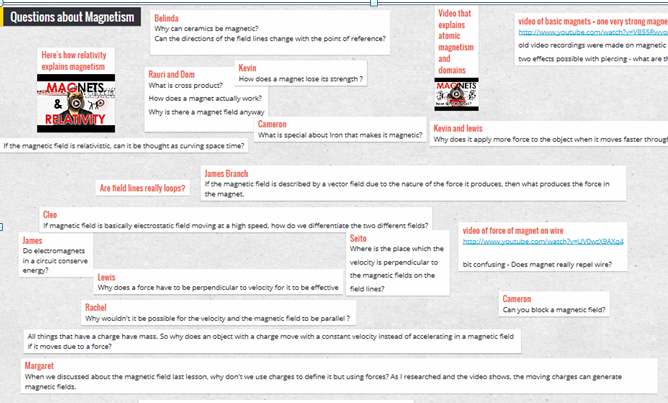
So I have been experimenting with flipping in two ways. First the students were asked to watch a couple of short videos. Recently I asked upper sixth students to watch the Khan Academy introductory lessons on ‘Magnetism’ before we began an A level treatment f the subject. Rather than ask them to answer questions, I asked the students to record what questions they wanted answered having watched the videos.
I used Padlet (see below) as a notice board for the students to record their queries. I have two groups in parallel, so they could see each others’ thoughts. The students’ questions influenced what I included in the following lessons. At the end of the classes I displayed the Padlet board and students discussed what had been answered and what hadn’t. I added links to other videos that clarified some ideas that had been queried (most relevant from Veritasium, One Minute Physics).

padlet e.g.
I am happy that nearly all the students posted questions. After my lessons and the extra video links people either said their questions were answered, or asked more questions (hooray!). I think that seeing each others’ queries encouraged some of them to think more deeply – but that’s anecdotal from my knowledge of the individual students. I moved their sticky note questions around to group similar queries, then posted a relevant video link next to them. This also allowed for differentiation. I only posed one stimulus question (Are field lines really loops?) as a result of lesson discussion, another time I hope I’ll do more.
On the SAMR scale of use of digital techniques in education I think this is moving from ‘Modification’ to ‘Redefinition’ as students were responding both to ideas from other students in their class, and also to those in a parallel class. Another time I’ll ask them to suggest answers or resources that answer queries. As to the four Cs, certainly communication and collaboration went on. Some critical thinking in subsequent discussion. Not so much creativity. Using TPACK to analyse what happpened, certainly there was useful content, and the technology enabled access to the content resources and communication between students. I used pedagogical knowledge to choose suitable videos. I must confess I deliberately gave them the drier Khan Academy approach first, so that my lessons and the Veritasium videos reassured (hopefully) the students that they could follow the arguments in what is a difficult subject at A level.
On a technical note, I had been using Lino (http://en.linoit.com/ )for notice boards like this. I experimented with Padlet (http://padlet.com/ ) as I saw it recommended in several blogs. Padlet is extremely simple to use but I may go back to Lino as I like the colours (this may be a rather sad reason) and the different set up options so that I can monitor who is posting (essential with some classes). I’m also using student blogging so that students can read and comment on each others’ ideas – next post.

Posted in education | Tagged , , , , , , | Leave a comment

Motivation 2 – Extrinsic Motivation

In my last post I wrote that students with intrinsic motivation were most likely to be successful learners. But in practice I know that I, and my students, sometimes need some extrinsic push to get a task done. So in this article I’m going to list techniques that I have found to be successful, with a little bit of analysis as to how and why I think they work.

Deadlines

It is a truth universally acknowledged, that urgent trumps important every time. I understand that I should take the long term view, but knowing I must have something ready tomorrow (or even later today, but I’m not admitting that) is a powerful factor in focussing my attention.

So how can we make deadlines work for students? First – ensure students are aware of due dates for work. Whether they record tasks on mobile devices or use ink in a paper notebook, all students need a one place reference list of what they must do and by when. We take care of this with young students, but as they get older we don’t always support them as much as they need.

Second – make those dates matter. I don’t mean that if students miss deadlines the work gets missed too. But if students get behind with their deadlines then they need to know when and where there will be support for them to catch up, and the absolute expectation that they will do this. Coursework is disappearing from the specifications; I have mixed feelings about this. But what I shan’t regret are the comments when I announce intermediate dates for different sections: “But, Miss, those are just your dates, right? When must it be in for the exam board?” and the subsequent discussions. The deadlines set by their teacher have to be valued by students.

Enforcing and following up the completion of tasks is frustratingly time consuming for teachers. However hard we try to convince students that we are supporting their learning, as we insist they come back and finish their work in a classroom where we are present to help them, most students regard such requirements as detention and punishment.  I try to remember the students who object furiously throughout the school year, and then send me ‘thank you’ s  at the end of the course. But the percentage is not very high.

Feedback

‘Specific ‘and ‘prompt’ are my keywords here.

I’ve read criticism of feedback that is personal. Many authors seem to feel that teachers who begin with phrases such as, “Good effort, Tom,” continue to focus on congratulating a student for trying, rather than giving feedback that is specific to the task. I still try to do both.  Some authors criticise “Two stars and a wish,” but I think all of us respond better if progress that we’ve made is recognised. So the ‘stars and wish’ should be for actual attainment, for example:

“Well done, Susan, you’ve described what happened in the experiment accurately. You have used the correct names for all the equipment this time. To move up to a grade B you need to use scientific ideas to explain why it happened this way. For an A grade I should need to see you using the density equation, and explaining what happens to the air molecules.”

Achievement is recognised, progress commended (‘this time’), and requirements for improvement specified.

‘Prompt’ is a challenge for busy teachers, but we have to set an example! How can we expect improvement with the next assignment if students haven’t received feedback on the last one?

Rewards Celebrations

Quizzes and competitions with sweets and chocolates handed out to the winning teams leads to a happy classroom in the short term. But an expectation of a lollipop for a good mark benefits no-one in the long run, except dentists maybe.

So how do we strike a balance?

I liked an idea I saw a few years ago (sorry, can’t remember whom to credit). Treats are never earned, they can never be expected as the outcome of successful study or compliant behaviour. They are an occasional celebration when things are going well, to be enjoyed (by all, hopefully).

Most of the time recognition and praise (we all like praise!) will do the job. Exemplar work on display, stars, merits etc all augment the feedback process.

Consequences

In an ideal world a look or a word would be enough to bring a miscreant round. And if we notice what’s going on in time (and developing strategies to keep an eye on the rest of the class while paying attention to one member is a valuable skill, even if it does force a teacher into the position adopted by the social climber who scans the party for someone more interesting while apparently paying attention to the stopgap they’re listening to) then naming or nodding to a someone off task often pre-empts anything requiring more intervention.

But we can’t prevent things happening to students in their life outside our classrooms. Sometimes for one reason or another, a student prevents other students learning. Sometimes sanctions are needed. And students need to see that expectations are enforced. But, personally, I could never say I use punishments consistently. Because each student is an individual, and a rigid tariff of repercussions for particular infringements is as inappropriate as forcing each member of a class to choose the most personally significant phrase/event from a novel.

Deadlines, feedback, celebrations and consequences of poor behaviour – four extrinsic motivators that can support both the development of intrinsic motivation, and supplement it. Which do you find most effective?

Posted in education | Leave a comment

Motivation 1 – Learning for its own sake

Every teacher longs for a class of students who are motivated to learn. But we need to do more than just yearn for such ideal students; we need to understand something about motivation, and how to build it in our students. Research shows that students with intrinsic rather than extrinsic motivation have more stamina, are prepared to think more deeply, are, in summary, more likely to succeed. But practice shows us that building intrinsic motivation is harder.

Let’s think about intrinsic motivation. (I’m basing this summary on an article by Kaplan, reference below, which has links to original sources). We can start with Maslow, and his higher order ‘needs’, self-actualisation needs which are only engaged when the basic physiological requirements have been met. Later researchers (e.g. Ryan and Deci) developed Self Determination Theory. This holds that after physiological needs there are psychological – for competence, relatedness and autonomy. Only when these three organistic aspects are fulfilled can a student develop intrinsic motivation for learning. At this point flow is possible, that state where engagement is so complete time passes without the students’ awareness, self-consciousness is absent and concentration on the topic is so complete that all external concerns are forgotten (flow is a term coined by Czikzentmihalyi). Flow is most likely when there is the best balance between the challenge of a task and the student’s abilities. In a positive spiral, the experience of flow is so rewarding that the student is motivated to repeat it, so grows in competency and understanding.

So what are the implications for teachers? First to ensure that those three psychological needs are met. Students need to trust that they will be able to achieve measurable, recognisable success with any task that is set to them. And our feedback must be genuine. If we give ‘two stars and a wish’, those praise stars must be recognition of real effort and achievement that shows progress. Students have to know that the target wish is an achievable challenge, and that further progress towards it will be mentored. Then creating an atmosphere which encourages risk taking, knowing getting things wrong is often a necessary step on the path to getting it right, creating a space where trying things out is encouraged. (Easier to achieve with younger students than when adolescent hormones are screaming that the student will never find a mate if they show any weakness. Overcoming the teenage belief that a blasé indifference to study, or any other effortful activity, appears more cool than being seen to try sometimes seems the hardest task for secondary teachers). And autonomy, handing over some control, giving the student some choice in method and presentation. Here is where being a 21st century teacher gives us an advantage – it has never been so easy for students to access help and information in different ways, or to produce and submit work in different formats.

So the first task is to prepare the ground. But then, like all real teachers, we have to face the specification that we are tasked to teach. Is what we have to teach intrinsically motivating? There is a temptation to seek a context that we think is attractive to our students: Understand the physics of motion to improve your football skills, learn about normal distribution and never be confused when meaningless statistics are used to back up a claim, study the requirements for plant growth and solve world hunger. Seeing the big picture, as we do, we can see links, more or less tenuous. But it is dangerous to try to twist the whole topic to fit a particular example. Initial engagement may turn to disillusionment when real contexts are too complex for the theory we can cover, or, conversely students need to learn techniques beyond that required in our examples.

Increasingly I believe that although it is important to give students a context for what we shall study, this should be almost more of an excuse for us to go ahead to have fun solving the problems we are going to learn about. Most of us can remember the satisfaction of solving a page of quadratic equations, or a set of grammar exercises, many of us continue to enjoy puzzles such as Sudoku or cryptic crosswords, or electronic games. If we accept that intrinsic motivation is the best kind of motivation, perhaps we should accept that that motivation should be contained within the subject, as well as in the student. In another words, learning is a good thing to do in itself – if there is a useful application so much the better.

Steve Wheeler has recently put an academically referenced post on Maslow on his Learning with e’s blog, “Going the extra mIle.”

And for a deeper look at the emotional side of motivation you might like:

http://pragmaticreform.wordpress.com/2014/05/31/motivation-emotion/

Next blog – extrinsic motivation

Kaplan reference via http://www.education.com/reference/article/intrinsic-and-extrinsic-motivation/

Posted in education | Tagged , , , , | Leave a comment

First (Physics) lesson with a new sixth form class

I teach in a school with a sixth form which has an appreciable new intake to study for A levels, who join established students who already know each other well. I think the challenge for the first lesson is to have an engaging lesson, with some interesting material, and simultaneously to encourage students to collaborate and begin to reform as a united class who will work together. I appreciate the need to give a big picture of what we shall be studying, and the admin necessary for resources issue and explanations of expectations. However I also know that students have had a programme of introductory activities and that in every subject they will be hearing similar things. So my approach for many years is to have resources laid out ready, and to move on quickly from their listening to me, to the students working on an unfamiliar task.

What task? In different schools, over several decades, I have shared Physics teaching. And my section has often begun with materials, sensors or kinematics. So here are some ideas that I’ve used which may be adaptable for other subjects:

Materials (a sweet start) :

The way I teach materials was transformed when I taught the Salters Horners Advanced Physics course, when I learned that almost all material properties could be studied via confectionary. Students find it a difficult topic, as there is a great deal of technical descriptive vocabulary, whose meaning is precise within the context of material science, but which contains words that are used less precisely in ordinary life. For example ‘toughness’ refers to the energy required to break a sample, while ‘strength’ refers to the force, and a brittle material like glass may be strong but not tough.

So in the first lesson I give students a glossary sheet, with A Level standard definitions, examples and antonyms. I pair students together, trying to put new students with those who are old hands. This sets a pattern – that I sometimes tell them who is to work with whom, during the year I’d expect to ensure that each student collaborates with each of their classmates in different activities. Each pair is given a dish of mixed sweets (usual precautions about allergies, and cleanliness).

After 15 minutes or so each student must introduce their partner to the rest of the class (name, what they are studying, where they are from, why they are studying Physics), and then each pair describes compares and contrasts their sweets, using as many of the words from the glossary sheet as they can. The rest of the class are encouraged to ask questions for clarification.

This activity has collaboration, communication and critical thinking built in. Next year I plan to extend it with either Lino or Socrative. I’ll ask students to create sentences that show they understand the meaning of the words they have been using. If we use Lino, the sentences can be displayed anonymously, but I’ll have an email telling me who has posted what, in case the students have not quite reached the maturity we’d like in the sixth form.  I can also freeze the IWB display so I can check what’s posted on the computer screen, before showing it to the class. Then students can comment on the sentences to improve or correct them.

Resources: sweets – usually in a clean Petri dish. Contrasting examples might be – plain, milk and white chocolate squares, boiled and jelly sweets, caramels and boiled sweets, liquorice and strawberry laces, fruit and nut versus smooth milk chocolate, gums and boiled sweets… A couple of clean sheets of white paper, students can create a hardness comparison by seeing what sweet scratches what.

Glossary Material Words, follow up multiple choice test, Materials Properties Quick test

Sensors – an intro to useful electric circuits:

The lesson structure is the same as for ‘Materials’, but this time each pair moves to a different sensor device or circuit. The Physics task is to identify what the sensor responds to, and the output it produces. Students are then asked to consider how the sensor might work, and where it might be useful. A large class may have to work in threes – you need time for their presentations.

Examples: Thermocouple connected to digital voltmeter ( junctions labelled), thermistor connected to resistance meter, thermistor connected in potential divider (output to voltmeter), digital ‘tape measure’, dB meter, I use an old birthday card with sensors that enable the opener to ‘blow’ the candles out, pressure sensor, lux meter, light gate connected to timer, GM tube and counter (background count only!).

Follow up to the presentations and discussion could be a photo of each sensor and brief notes, written by the presenters. These could go on a class blog, and students could be required to write a minimum number of comments in a further activity, giving the chance to reinforce ideas of digital etiquette.

Kinematics –average speed:

Again, same lesson structure, but groups of three students each given the challenge to measure the average speed of a trolley down a runway by a different method. If each member of the group takes a separate set of results and then the students look at the spread, they can begin to think about uncertainty and what causes it. It is difficult to manage this in the first lesson, vital to have equipment set up beforehand.

Methods I used last year: In each case, one runway, jack to prop up one end, one dynamics trolley; hand held stop clocks and a metre rule, light gate positioned over centre of runway measuring time for card attached to trolley to pass through, light gates at beginning and end of runway measuring difference in times of interruption, ticker timer and tape, the last group had the linear air track, glider and a more precise timer connected to the light gates.  The aim was not to have a definitive answer between all the groups for the speed, but to appreciate effects such as the card moving through the gate at an angle, the trolley moving down the slope at an angle, decisions about where the distance began and ended i.e. to get a more sophisticated appreciation of causes of uncertainty than most students have during GCSE.

Last year as follow up to the presentations each group produced a poster, with a photograph of the equipment, explanations and results. Perhaps this year I’ll have a class blog space set up in time.

Posted in education | Tagged , , , , | Leave a comment

Revisiting thinking frames

It is some years since I was introduced to a particular writing frame structure, developed by a group called the AstraZeneca Science Teaching Trust, supported I think by Hampshire CC and by the University of Southampton, (for details see http://www.pstt.org.uk/ext/cpd/the-thinking-frames-approach/getting-started/introducing-the-levels-mountain.html). It was specifically designed to help students (KS2 or KS3) write longer accounts of science observations, and to reach higher National Curriculum levels of comprehension, modelling and analysis. I have used it with older students too.

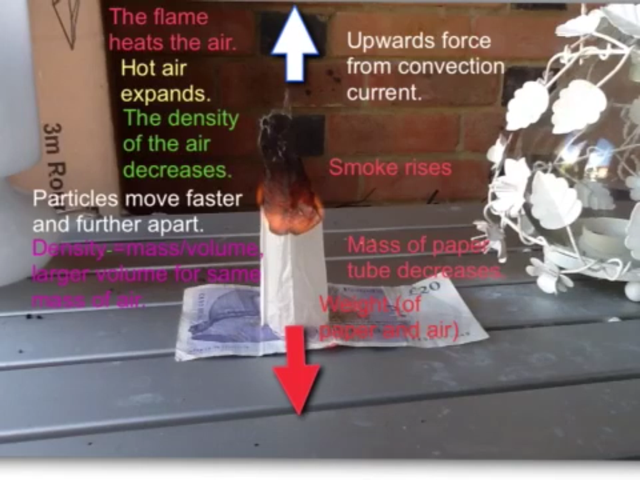
An example will make it easier to explain, and I should say, this is how I have modified the original model over the years. First activity is to show students an event with a surprising and/or dramatic outcome. My example today is the flying teabag experiment, there is a video for those who are not familiar with this simple demonstration. I think the method could be useful in subjects other than science, but I’ll stick with one I know well to begin with.

Students watch (or perform) the activity, and then draw three (cartoon) pictures to summarise the sequence of events. While they are drawing I collect vocabulary they might use to describe or explain what they have seen, and write it on the IWB. Usually every member of the class can be asked to contribute at least one word. Then the students use the words to label their diagrams (I usually set a minimum requirement). If students offer extra vocabulary I add it to the board. I ask the students to write sentences, first to describe what they saw happen, then to explain. I challenge individuals to add explanations at greater levels of complexity (in terms of the movement of particles/air molecules, explaining how the density equation is relevant, linking to ideas of forces and flotation). The final task is to change their sentences into a logical paragraph, this is often an out of lesson assignment. Assessment for learning is built into the activity, as teacher I can applaud what is achieved while specifying what is needed to improve.

As it is, this is an engaging lesson that results in real learning. How to develop it with the resources we now have in the classroom? First the vocabulary list on the IWB can be sent as a PDF to class members. I find that many ask permission to photograph it anyway. All our students now have iPads, so they can video experiments. As on the video I have posted on Vimeo (link below) students can use Explain Everything to add labels, still photographs and commentary. The commentary could replace the final paragraph or be an addition. My plan in the coming year is to have students collate all their digital work in an ebook. So they will be able to add the completed video, and the feedback it receives, as they build the ebook in CBB.

Differentiation is built into the process, whether we use NC levels as in the original scheme, or other criteria. Individuals can be challenged to more critical thinking, and employment of more sophisticated concepts during the ‘writing sentences’ stage and in afL. Whether students draw cartoons or edit their own videos their is plenty of scope for creativity. As the exercise stands the collaborative process is in the classroom. Communication skills are enhanced as students are encouraged to use correct technical vocabulary and to create complete sentences and longer passages.

Here is the Vimeo link: (here is the URL if the link fails https://vimeo.com/100989384).photo

Other Physics activities that would be suitable: candle under balloon half-ful of water, sparkler on electric drill, bromine diffusion in air and into vacuum, candle floating at oil/water interface, raisins in sparkling water ‘lava lamp’.

Posted in education | Tagged , , , , , | Leave a comment